Professor Zandria F. Robinson
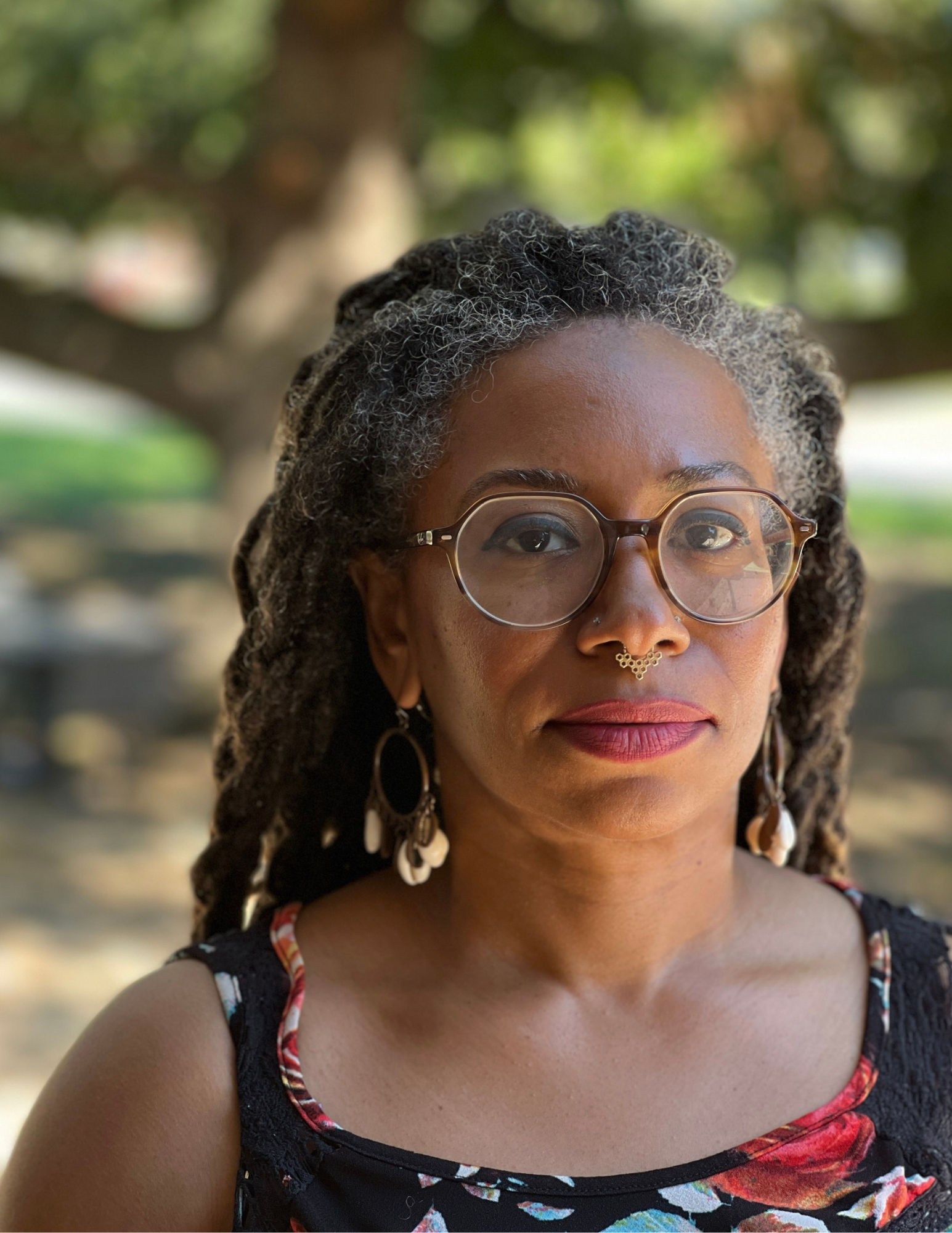
Photographed by Tauheed Rahim II
Dear Reader, Zandria’s letter contains mentions of loss and suicide. We advise those who may be triggered by these topics to exercise caution when reading this letter. If you are struggling, please reach out to one of the resources listed on our Resources Page.
If You’re Reading This, Grief and Joy Can Exist in the Same Space
I planned my first memorial service when I was 22 and entering my second year of graduate school. It was for my daughter’s father, DeMadre, 25, who had taken his life a week and a half before his last semester of college. He was a history buff from the San Francisco Bay Area who loved learning about resistance movements and singing off-key. His death shocked our campus community. He had been the friendly, familiar face that greeted many of us on the late shift in the campus computer labs as we spent the night banging out assignments we’d promised ourselves we wouldn’t procrastinate on. I somehow understood how essential it was for us to gather to remember him, to share stories we’d each collected in our all-too-brief time together, stories that had now taken on new, final sorts of meaning. From the margins of the gathering space with our daughter, then 14 months, hoisted on my hip, I passed out the programs I had designed and printed to late arrivals, whispering to them where they might squeeze in to sit, putting their confusion and condolences in my left pocket. As the silence eased into stories, some about his quiet generosity, others about his calming presence, and still others about his hilarious antics—he was a notorious practical joker and an unrepentant public farter—people’s eyes became puddles of red and blue tears, grief and joy dissolving into a marvelous purple that would splash across the rest of our lives without him.
There are countless books about grief, theorizations of the process, accountings of what it can look like, of how it both follows a discernible pattern and can be highly specific and individual. Social media collects, distills, distributes, and, of course, sometimes distorts this literature on grief, such that we are overwhelmed with grief theory and the supposed appropriate action steps to manage it. Moreover, what we believe about death, transition, and losses and endings of all sorts, and what we do in the aftermath of such experiences, is in many ways predetermined for us: by our socialization and religious upbringing, our personalities, our social location and circumstances, and social norms. When we are left trembling and spent at grief’s threshold with no choice but to cross, we often find that the tools we’ve been given are insufficient for the journey.
In the years after Madre’s death, I planned and/or attended the memorial services of several family and friends. I dealt with the everyday endings and transitions of relationship breakups, my daughter not needing me to cross the street with her to school anymore, and the cancellation of beloved television series. And like many millennials, I grieved war, the Great Recession, police violence, and the loss of a promised future of progress. Though I developed religious practices to manage grief, I was still dancing around it, wary of its sting. After all, I had coursework to finish, a thesis and later a dissertation to write, students to teach, books to finish, and couldn’t be derailed by emotion. I ultimately decided that muting my joy was a small price to pay to not feel the blue-heart pain of grief, and that keeping grief at bay was essential to my academic and professional success. These were the lies I told myself. I quickly learned that ignoring or avoiding grief only made it louder, and that in hiding from it, I was also inadvertently hiding from the full goodness of life.
Grief is often better with friends, and I was sent a good one a decade after Madre’s death, the kind of friend who knew about how tragic loss at a young age can twist your worldview, make it so your smile doesn’t smile all the way, no matter how you try. Malaika was a consummate creative, a community cultivator, a writer, and a caring educator whose spirit entered the room before they did. We spent years knowing of each other, in each other’s orbits but only exchanging pleasantries. That is until our daughters, Amina and Assata, found each other, as Gemini daughters want to do. Born four days apart, they were sisters, they told us. Their sisterhood seeded ours, which grew as they did, and as they patiently raised us up into the kind of mothers they each needed.
Malaika and I had both navigated tremendous loss in our young adult lives, and we spoke often of the ways this grief came to sit beside us on our sofas at the most inopportune moments, of how it snatched our covers at night and left our feet iceblocks, of how it sometimes sat on our chests until we acquiesced to listening to its song. And yet it was this understanding of grief, combined with our laughter and foolery, our epic meme exchanges, that formed the foundation of our decade of deep friendship. It was this cultivation of joy that made room for us to make better relationships with grief.
In one particularly difficult period after my father’s sudden death, Malaika gave me Thich Nhat Hanh’s No Mud, No Lotus. They always seemed far ahead of me on this grief work road, and they always offered the right word at the right time. I committed to building a real grief practice, one that made room for me to attend to difficult feelings, which in turn expanded my capacity for joy, laughter, elation, wonder, and hope, even through the most challenging circumstances.
And so it came to pass that twenty years after Madre’s death, ten years after our daughters decided to be sisters and so we as good mothers followed suit, I was planning Malaika’s memorial service. A seizure had rocked them one winter night from this life into the next. The shock of it, of Amina’s voice on the other end saying words I could not comprehend, was of the entire ground ablaze, crumbling beneath bare, raw feet. I flashed through our last conversations, our last FaceTime call, scrolled through our texts, remembered their smile not smiling all the way on their 45th birthday photo. And I remembered what they taught me about life, loss, grief, transition, and joy. And on the third day, I began to make the phone calls to assure their wife and children I would help handle things in the way they wanted, and to let the grief in so I could feel the joy of all of their time on earth.
In the months before their death, Malaika had begun a Substack for their musings, a place to become less precious about putting their ideas out into the world. Like many writers, Malaika was known to have any number of projects going at once, projects I wanted to pry from their hard drive and put into the world, but that I contained myself about so that they would continue to share them with me at their own pace. Our texts and emails are filled with each other’s gorgeous, shitty first drafts, newborn ideas beautiful in the moment but destined to grow stunning, bigger, stronger, different in the future if we tended and loved and fed them.
In one of Malaika’s last blog posts, they wrote about two significant losses, news of which came on two successive Mondays, and what sitting with the grief spurred them to do:
To write out loud.
To share out.
Move some pieces from Post-Its, journals, and my brain to places where they can be seen.
To face down the fear of failure and success.
To move the needle by starting the conversation with what I think and feel the deepest right now: the loss of 30 people close to me in under a decade. And how the losses created and fueled Grief and Joy Can Exist In the Same Space (an idea, a book).
We are entering the part of the fall season where the veil between the living and the passed on thins, where the threshold is more prominent, where the songs from the other side shine brighter in our spirits, a time during which many religious and cultural traditions, from Black American hoodoo to Día de los Muertos to All Hallows’ Eve, honor the threshold. In this season, I offer you Malaika’s words, their encouragement to themselves, as action and balm: to write, to share, to move, to face down our deepest feelings of loss. Unaddressed feelings of great personal loss, as well as local, national, and global violence, teem around us. In this moment, in which grief of some origin, of some form is beckoning all of us to cross its threshold, these are actions we can take as human-centered thinkers, scholars, leaders of this generation and the next. We are called to join hands together and move across the veil, across grief’s threshold, to honor and witness what’s there, the causes and consequences of grief, so that the joy available to us can rise and move, too. It is only by allowing them to be together that we can be clear about our mission and purpose, that we can thrive. If you are reading this, grief and joy can exist in the same space..
Zandria F. Robinson, Associate Professor and Chair, Department of Black Studies
Connect With Us
To follow IfYoureReadingThis at Georgetown on Instagram, get in touch with our chapter, and learn about more resources available to Georgetown students, visit our chapter’s homepage.
AUTHOR CONTACT
This author has opted to allow readers who resonate with their story to contact them. If you would like to speak to the author of this letter about their experience, please use the form below.